








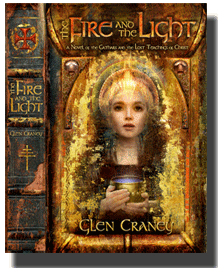
I took as my lodestar the admonition of historian Zoe Oldenbourg: “If the centuries had preserved the work of some Catharist Vaux de Cernay, telling the deeds and gestes of his spiritual leaders, the miracles God had wrought on their behalf, and describing the grandeur of their work, then no doubt the Crusade would present a radically different appearance to us.” (my emphasis)
Implicit in this lament is the possibility that history has failed to provide us with the full story of the Cathars.
In such cases, it falls to the historical novelist to imagine what might have happened, but can never be proven or flies in the face of extant accounts.
I have thus used and relied upon many of my own suppositions, creations, interpretations, and certain variances from the few contemporaneous accounts of the Albigensian Crusade left to us. As with any novel, there are by necessity imagined thoughts, motives, conversations, and actions.
Readers who prefer their historical characters to remain untarnished—and yes, perhaps even undistorted in the process—by the bending lens of fiction, who reject the possibility that medieval “facts” winnowed through the uneven sieve of time may not be as reliable as one might wish, who find fanciful the suggestion that a religious group under persecution might not have divulged all of its esoteric practices and tenets in surviving writings, or who may be offended by certain venerated persons being reimagined or dramatized in a manner that conflicts with their own inherited history, personal traditions, and spiritual inclinations and beliefs, would perhaps best be advised to look elsewhere for their reading.
Even today, there remain widely divergent, and passionately held, views about the Cathars and their beliefs. Many admirers and guardians of the faith dismiss any connection to such concepts as the Holy Grail, mysticism, and the Tarot, considering these distortions, inventions, and wrongful appropriations. Others see the Cathars as a link in a longer chain of an esoteric tradition that has repeatedly been forced to go underground and protect precious arcana. To tread into this fray is to gain a taste of what the bitter theological conflicts of the 13th century must have been like.
Jane Austen understood the sometimes difficult and potentially subversive task of the historical novelist when she had her heroine in Northanger Abbey remark about history, “I often think it odd that it should be so dull, for a great deal of it must be invention. . . ”
For independent-minded readers, who take to heart my suggestion that they consult other works on the Albigensian Crusade and draw their own conclusions about the controversies that still swirl from that period, I would ask them to approach this novel remembering the insight of author Tim O’Brien, who wrote about another war in his “How to Tell a True Story”:
“A thing may happen and be a total lie; another thing may not happen and be truer than the truth.”
